Generalization & Maintenance: The Missing Pieces of the Treatment Plan
Generalization & Maintenance: The Missing Pieces of the Treatment Plan
Every BCBA knows how this story goes: a child learns to request a snack during a session. The target gets marked as mastered, the graphs look great, the team is happy. Two weeks later, the parent tells you the child doesn't make the request at home. At school, same thing, the teacher has no idea what you're talking about. The skill only existed inside the therapy room. Outside of it? As if it never happened.
Generalization and maintenance have always been an essential part of the ABA clinical process. But until now, software never kept up with the reality on the ground. ABACare just changed that.
How things worked until now
The clinical reality is simple: acquisition is only the beginning. A skill isn't truly learned until it shows up in different settings, with different people, under different conditions. And until it persists over time, without active teaching. This isn't theory, it's foundational ABA.
The problem was never that BCBAs didn't know what needed to happen. The problem was that the tools didn't reflect the process. Paper forms. Sticky notes on binders. Or the classic workaround: move a mastered target back to active just to probe it again, then manually move it back when it passes. No structure, no visibility, no clear schedule.
ABACare now reflects the real workflow, the way you learned it and the way you practice it every day.
The software finally aligns with clinical practice.
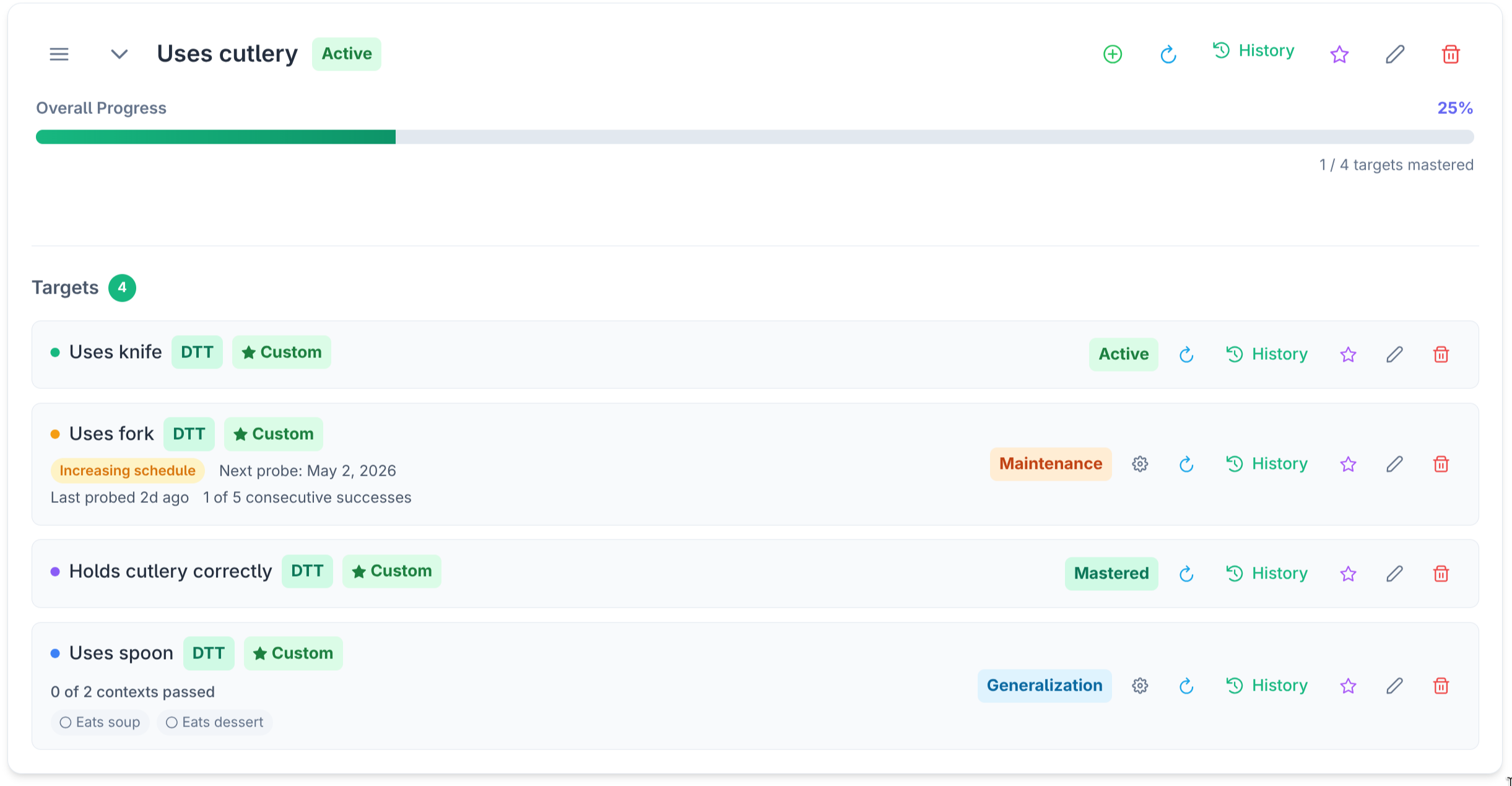
The full target journey, in the platform
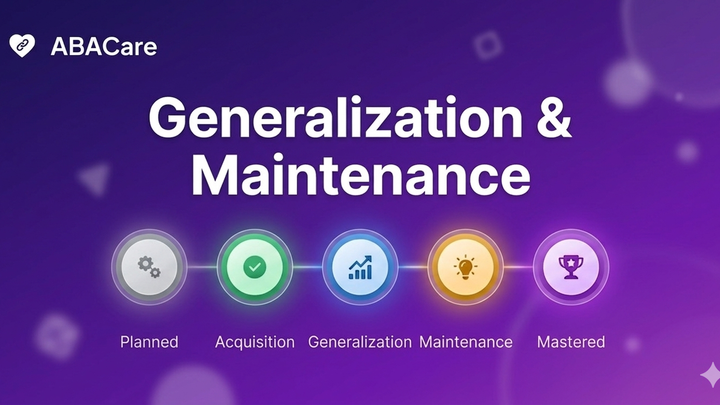
We added five statuses that follow the exact clinical path of a skill:
These statuses aren't administrative labels. They shape what happens to the target at each step, exactly how things work in the clinic. When a target reaches Generalization, the system knows it needs to be tracked across contexts. At Maintenance, automatic probe scheduling kicks in. And when it reaches Mastered, there's a documented trail behind it: how, where, and when that skill was verified.
What you were already doing with pen on paper now happens directly in the platform.
Generalization: testing the skill where it matters
In ABA practice, an acquired skill must be demonstrated across multiple contexts before it can be considered generalized. ABACare now turns this principle into concrete functionality.
When a BCBA moves a target into Generalization, they define the contexts where the skill needs to be demonstrated. For example:
- Home: does the child use the skill with their parents?
- School: does it work in the classroom too?
- Community: at the store, at the park, at the doctor's office?
- With other people: does it show up with other therapists, teachers, grandparents?
Each context is tracked separately. Aides record pass or fail for each context during sessions. The BCBA decides how many contexts need to pass before the target can advance. Maybe all of them, maybe three out of five. It's a clinical decision, not a system one.
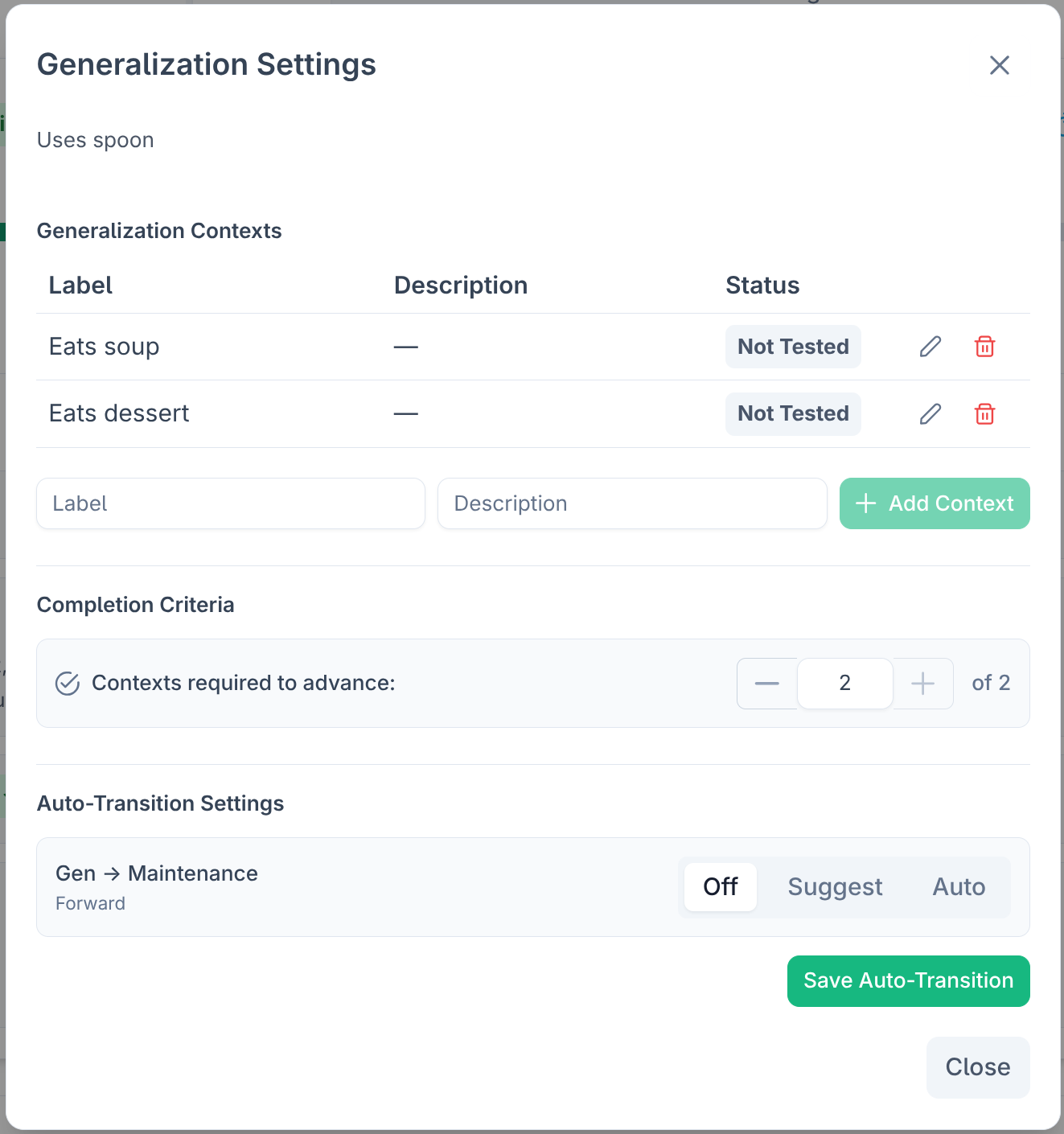
Progress is visible at a glance. No more flipping through binders or searching through session notes to find out whether a skill has been tested at home yet.
Maintenance: proof that the skill persists
Every BCBA knows that a skill that isn't tested periodically can disappear without anyone noticing. The maintenance phase exists for exactly this, and ABACare now brings it into the platform with a structured probe scheduling system.
After generalization, the target enters Maintenance. The BCBA configures a schedule that defines how often and at what pace the skill should be tested:
Increasing Intervals
Start at 2 weeks, then 1 month, 2 months, 3 months. This is the most common clinical approach: probes are gradually spaced out as the skill solidifies.
Fixed Intervals
Probe every N days, no variation. Suitable for skills that need regular, predictable check-ins.
Custom Intervals
Create your own schedule for clinical situations that don't fit the standard patterns.
The system keeps track: when the next probe is due, whether there are overdue probes, how many consecutive successes have been recorded. The BCBA decides how many successful probes in a row are needed to consider the skill truly mastered. Or they can mark the target as permanent maintenance, for skills that need long-term monitoring.
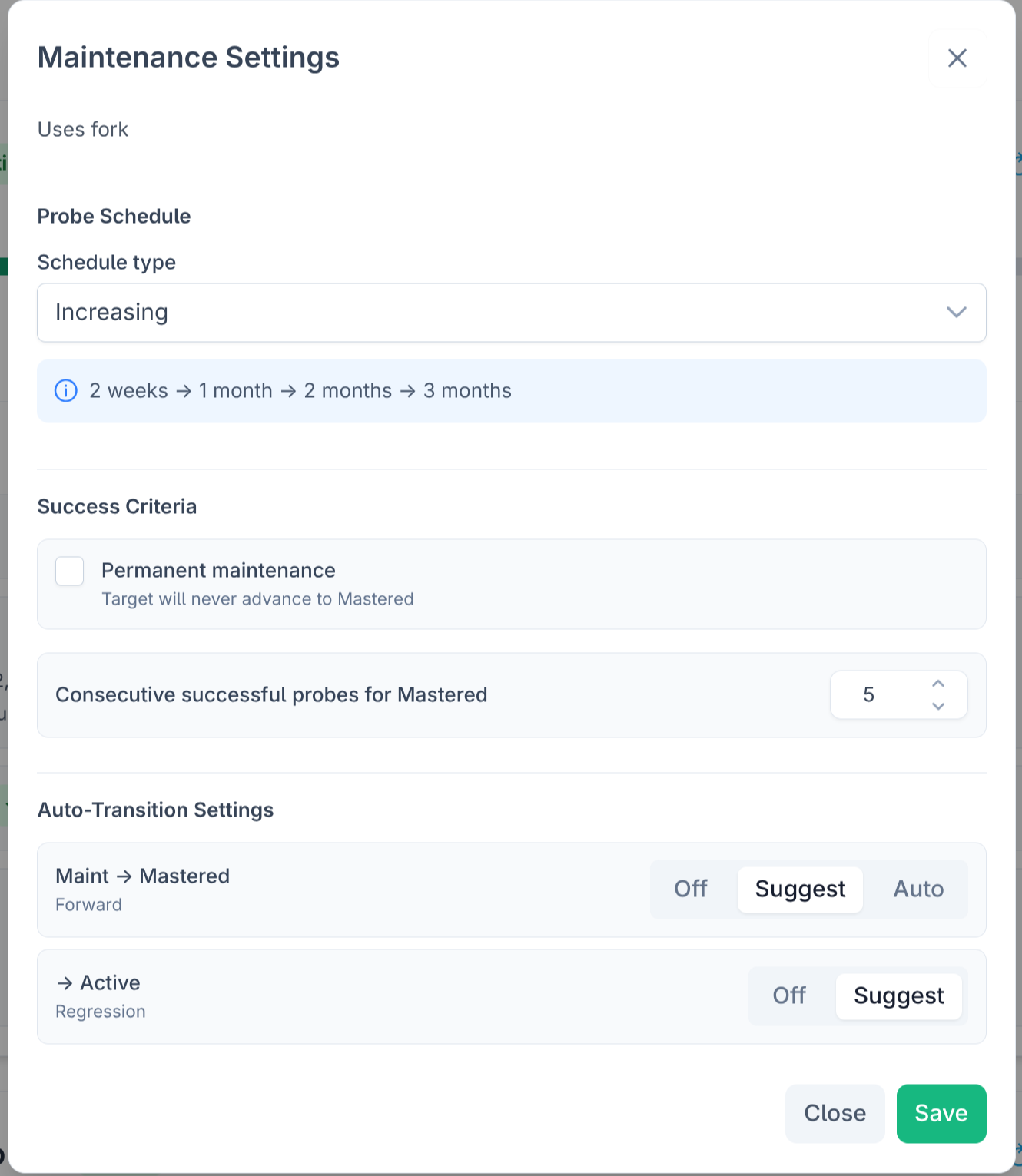
If a probe fails, the counter resets and the schedule goes back to the first interval. Just like you'd do on paper: any sign of regression means more frequent testing, not looking the other way.
Automation that respects clinical judgment
One thing we heard constantly from BCBAs: we want automation, but we don't want the system making decisions for us. We listened. We implemented three modes for status transitions:
- Off: the BCBA does everything manually (the default)
- Suggest: the system sends a notification when criteria are met, but the BCBA decides
- Auto: the target advances on its own when the criteria are satisfied
Each transition is configured separately: generalization to maintenance, maintenance to mastered, and regression handling. The BCBA chooses the level of automation, per target, per patient. Control stays where it belongs: in the clinician's hands.

What this means in practice
Beyond simplifying the workflow, this feature solves a real documentation problem.
Insurance companies and funding bodies increasingly demand concrete evidence: was the skill generalized? Was it maintained over time? Showing that it was acquired is no longer enough. With ABACare, that evidence builds naturally from daily activity. Every context test, every result, every status transition is recorded automatically as part of routine session data collection.
And for the children receiving therapy, the stakes are even more concrete. When generalization and maintenance are tracked systematically, skills actually make it into daily life: at home, at school, in the community. And they last.
Built on your feedback
This has been one of the most requested features since ABACare launched. BCBAs kept telling us the same thing: we need to track a skill from end to end, not just to acquisition, but until it becomes part of the child's life. This update is our direct response to that feedback.
Available now
The feature is live today, on all ABACare plans. If you're already using the platform, you'll find the new statuses in your treatment plan targets. Change a target's status to Generalization or Maintenance and the configuration options appear right away.
If you're looking for an ABA practice management tool that truly reflects the clinical process, we'd love to show you how it works. Schedule a demo and see the complete journey of a target, from planning to mastery.
Every skill deserves to make it past the therapy room.